
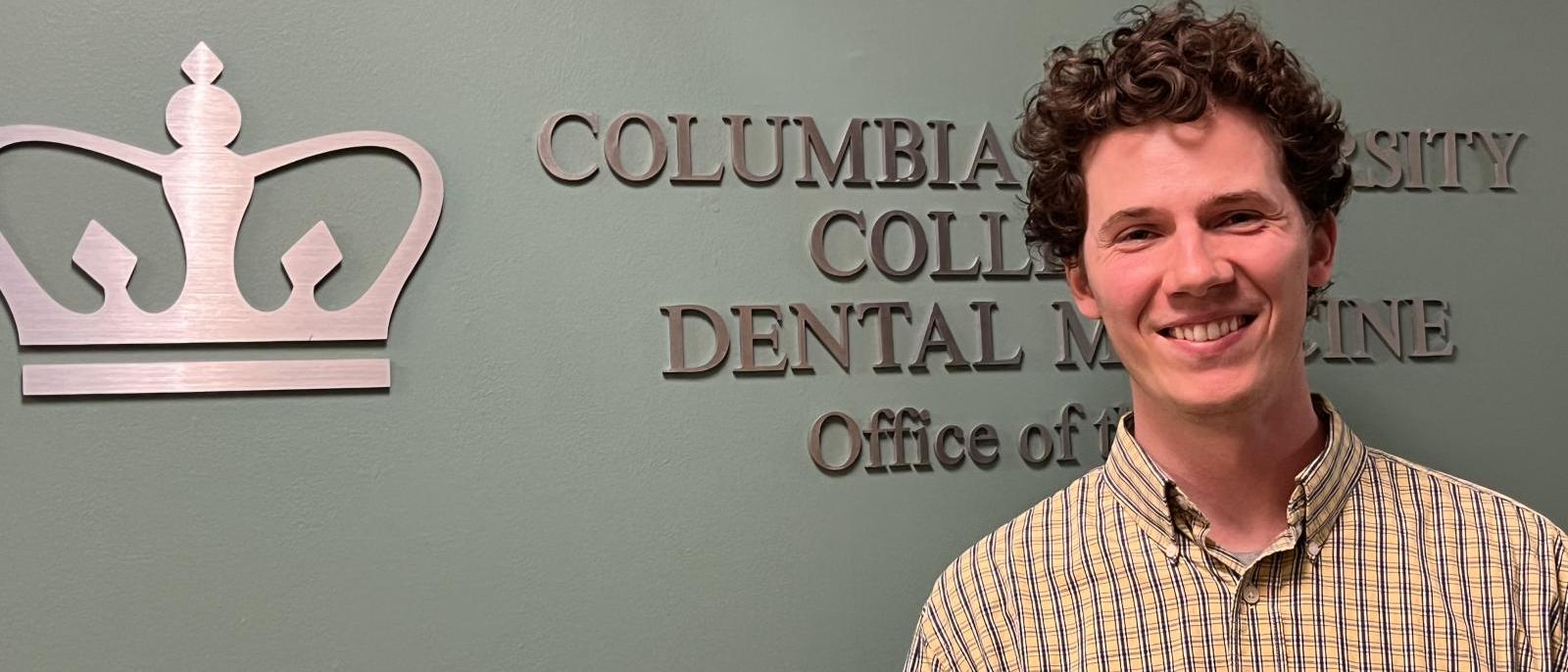
CDM Student David Pellei Selected for NIH Oxford-Cambridge Scholars Program
When David Pellei learned he had been accepted into the National Institutes of Health (NIH) Oxford-Cambridge (OxCam) Scholars Program, where he will pursue a PhD before returning to Columbia University College of Dental Medicine (CDM) to complete his DDS, he was sitting in a dark lab turning on his water bath and preparing his cells for the day. His cell phone rang, and to his surprise, it was the same person who had challenged him the most during the OxCam interview, sharing the news that he had been accepted.
“I wasn’t expecting it at all,” he said. “I was shocked. I didn’t tell anyone for two weeks.”
In the twenty-six years since the NIH OxCam program started, there has been only one other dental student to complete the intensive doctoral training program. Designed for exceptional students pursuing careers in biomedical research, participants partner with two investigators—one at the NIH and one at either Oxford or Cambridge University—to perform a single, collaborative dissertation project. Because the program follows the British system, students focus almost entirely on research rather than coursework and can typically complete the doctoral degree in about four years.

University of Cambridge, Cambridge, England. Photo by Claire Denison on Pexels.
Although the news came as a surprise to him, Pellei had been building toward this moment for years. His interest in research began during his undergraduate and post-baccalaureate studies at Virginia Commonwealth University where he worked in a lab studying anti-inflammatory approaches for periodontal disease. As soon as Pellei was accepted to CDM’s DDS program, he reached out to Dr. Chang Lee, associate professor of craniofacial engineering and director of research at CDM, and joined his lab as he began the program, eager to get started.
“David is unique, and I tell his story at every D1 research orientation,” Lee said. “I always encourage students to reach out to faculty as early as possible, and David is first place in terms of that.”
For Pellei, Lee’s lab was inspiring because it not only introduced him to cutting-edge work using stem cells for tissue regeneration, an area he plans to continue researching during his PhD, but also for its comprehensive nature, bringing together everyone from undergraduates to postdoctoral researchers. That environment gave him the opportunity to work closely with Dr. Meng Feng, an orthopedic surgeon and postdoctoral research scientist, whose emphasis on the bench-to-bedside connection influenced Pellei to pursue a translational career.
The experience also gave Pellei a clearer sense of what it would take to build a research career. “I realized the research I wanted to do was not something that could happen through an afternoon engagement,” he said. “Working with Dr. Lee showed me how much dedication goes into a translational project.”
That commitment continued throughout dental school. Lee described Pellei as a highly capable researcher following his post-baccalaureate year, noting that what sets him apart is his willingness to seek guidance. “He’s always been very curious and enthusiastic about research, coming to my office often to ask questions,” Lee said. “When he finds an opportunity, he seeks advice.” Pellei went on to complete CDM’s Summer Research Fellowship, present at the Orthopaedic Research Society (ORS) conference, which dental students rarely attend, and earn acceptance to the NIH Medical Research Scholars Program (MRSP).
At the MRSP, Pellei worked with Dr. Pamela Robey, the senior investigator and chief of the skeletal biology section at the National Institute of Dental and Craniofacial Research (NIDCR), on cell therapy and biomaterials. His research focused on induced pluripotent stem cells, which can be derived from skin or blood cells and reprogrammed into a stem cell state capable of developing into many different tissue types.
One area of focus for the lab was cartilage regeneration for patients with osteoarthritis. Pellei worked on differentiating these stem cells into chondrocytes, the cells that form cartilage. Because chondrocytes can sometimes turn into bone too quickly, the lab also studied a biomaterial derived from fibrin and thrombin that helps keep the cells in a cartilage state longer.
By the time Pellei applied to OxCam, five years of research had helped narrow his interests toward cartilage regeneration. The application was strengthened not only by that sustained lab experience, but also by the significant time spent refining the proposal and seeking feedback from previous OxCam students and others. Pellei made sure the science he was proposing would ultimately line up with a therapy or clinical application he could pursue in the future. For him, the relationship between research and patient care goes both ways: research inspires ideas for future clinical work, while future clinical experiences will help shape the questions he wants to study in the lab.
Looking ahead, Pellei hopes to build a career that combines research and patient care, with a particular focus on developing new therapies for TMJ-related conditions. Part of the appeal of studying in the United Kingdom is the chance to experience a different research and healthcare system. “I’ll get more exposure to different ideas and different approaches for how to solve problems,” he said. “When I come back, I hope to have a second lab skillset and twice the perspective.”
Pellei credits CDM with providing what he described as “a huge launch-pad.” His experience in Lee’s lab, the integrated dental and medical curriculum, the supportive administration, and the wealth of opportunities available to students gave him room to explore his interests and pursue new directions.
“We were surrounded by opportunities,” he said. “There was always something you could get involved with. If you had a passion, you knew there was going to be an opportunity for it.”