

A Graphic Narrative, From TMJ to OMG!, Raises Awareness of Jaw Pain and Paths to Care
Jen Leach and Dr. Maya Youness combine personal experience with clinical expertise to make information about temporomandibular disorders more accessible
When Jen Leach, a New York-based writer and cartoonist, arrived for her first appointment with Dr. Maya Youness, DDS, she had a long history of jaw pain. Since age 12 or 13, she had lived with clicking, grinding and headaches, but the hour-long appointment gave her an opportunity to explain her symptoms in depth to a specialist who understood her condition.
“I had never had a person ask me and listen so well about this disorder,” Leach said.
That appointment grew into a collaboration on From TMJ to OMG!, an educational graphic narrative about temporomandibular disorders, or TMDs. Working with Dr. Youness, assistant professor of dental medicine (orofacial pain) at Columbia University College of Dental Medicine, Leach set out to create the resource she wished she had as a patient. One of the central goals of the project is to correct a common misconception: calling the condition “TMJ.” TMJ refers to the joint itself, while TMDs encompass a range of disorders with different symptoms and diagnoses, a distinction Leach wanted patients to understand.
Leach discovered graphic medicine while earning her Master of Science in Narrative Medicine at Columbia, which she completed in 2019, and later made comics exploring experiences including bipolar disorder and breast cancer. She uses comics to advocate for patients whose experiences receive too little attention in medicine, including those living without a clear diagnosis or moving from one clinician to another in search of answers.
In July, she presented From TMJ to OMG! at the Graphic Medicine International Conference at Johns Hopkins University, sharing the project with a community dedicated to exploring the intersection of comics and health care.
“The comics form is so great because it allows you to show so many things at once,” Leach said.
In a single panel, a comic can show what a patient says aloud, what they are thinking privately, and what their body language conveys. For Leach, that ability makes graphic narratives a powerful way to communicate the experience of illness alongside medical information. The approachable format can invite someone to pick up a comic because it looks fun, then draw them into the complexity of the condition it explores.
Leach was put in contact with Youness through Dean Dennis Mitchell. Youness welcomed the project as a way to address misunderstandings about TMDs among patients and providers. After decades of misinformation and controversy over treatment, she explained, care is becoming more standardized and grounded in evidence.
“Jen had her own personal experience to share,” Youness said. “I think that makes it even more accessible to people.”
Youness wants patients to understand that jaw pain and dysfunction are common and, for many people, symptoms resolve with time. For those with persistent symptoms, evidence-based treatments can help manage and relieve their pain. She also wanted to offer a framework for recognizing safe, supported approaches and encourage caution around invasive treatments with less evidence behind them.
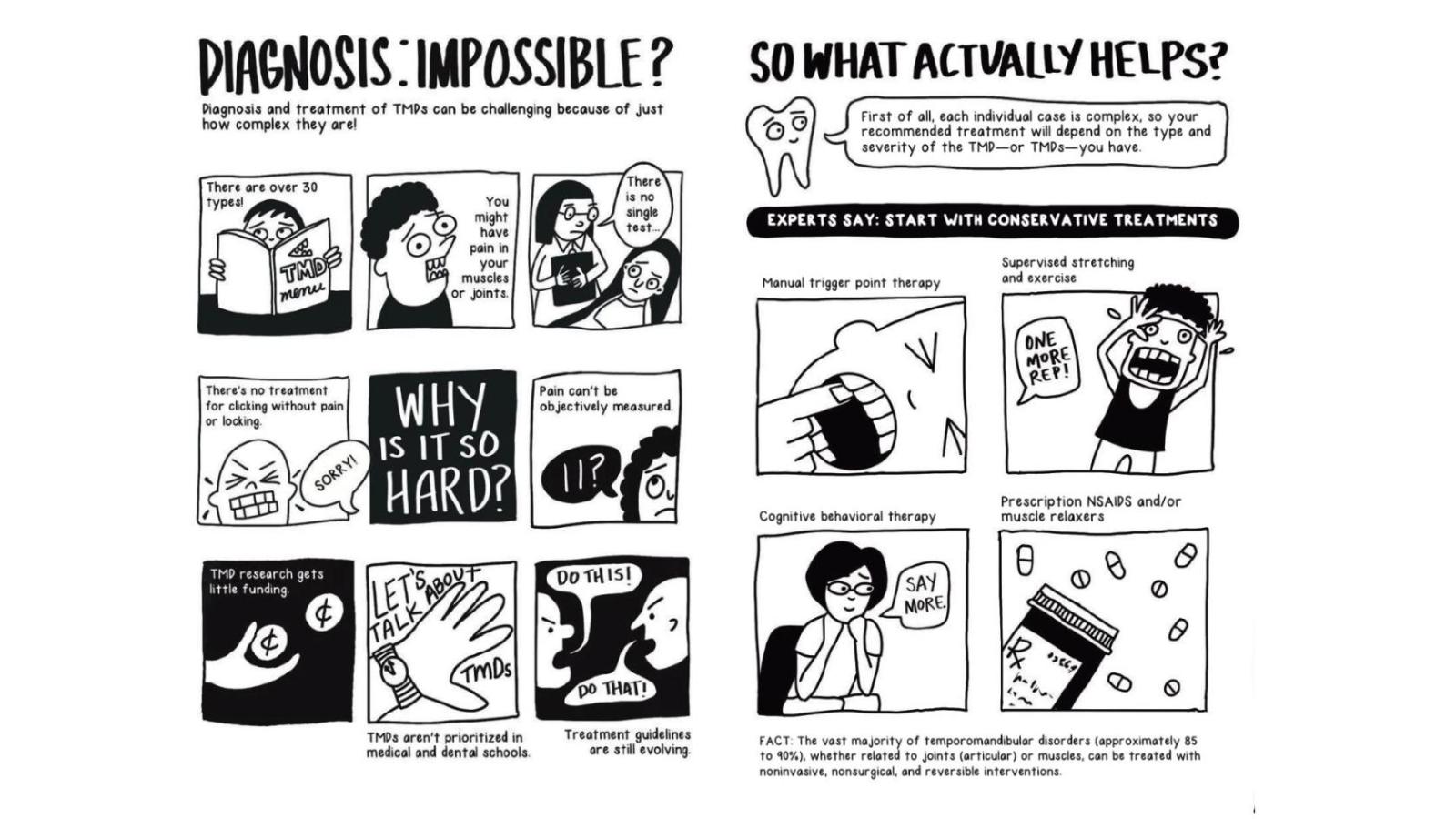
Excerpts from TMJ to OMG!
Finding appropriate care can be difficult, Youness explained, because education about TMDs varies across dental schools and residency programs. There are few specialized providers, particularly outside urban areas, and patients may see several clinicians before finding someone with the expertise to help. TMDs occupy a gray area between medicine and dentistry, which can create insurance barriers when both medical and dental insurers consider treatment outside their scope
“I'm hoping that it can guide them to the right resources of where to seek help,” Youness said.
Leach wanted to show how TMDs can overlap with other conditions and how different factors influence pain. She also wanted readers to understand that this complexity does not mean they are to blame for their symptoms. In drawing the comic, she worked to make the material approachable through humor while respecting how painful the condition can be.
Available free on Leach’s website, the comic is intended to reach patients and dental offices, helping readers understand their condition and recognize that support is available.
“I hope people will have hope, go a little easier on themselves, educate themselves, and spread the word,” she said.